
Starting an Online Business? Avoid These Common Website Mistakes
by Arjun S.
published – Mar 6th 2026
You’re starting an online business. That’s a big move.
You’ve got the idea—maybe even the product. You have talked to a few people. There’s excitement in the air. But here’s the part many founders underestimate: your website is not just a page on the internet. It’s your storefront, your sales rep, your brand voice, and sometimes your entire operation.
And this is exactly where many people stumble.
If you look closely at the most common online business mistakes, a poorly planned website sits right at the top. Not because people don’t care. But because they rush it. Or they try to cut corners. Or they assume a template will magically handle everything.
Let’s break down the website mistakes you should absolutely avoid if you’re serious about building something that lasts.
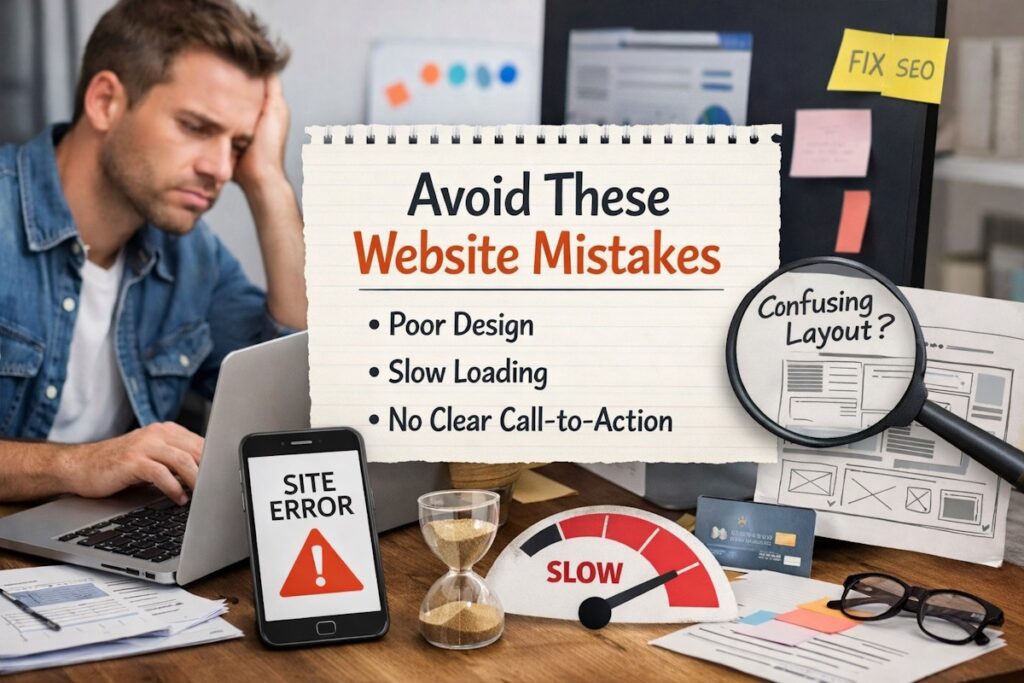
1. Building Without a Clear Goal
A surprising number of websites go live without a clear purpose.
Ask yourself: What do you want visitors to do?
- Buy a product?
- Book a call?
- Sign up for an email newsletter or a demo?
- Download something?
If your site tries to do everything, it usually ends up doing nothing well. Likewise, visitors land on your homepage and feel lost. No direction. No obvious next step.
A good website is focused. As a result, it guides users, removes confusion, and tells them what to do next without shouting at them.
Before you design anything, define one primary goal. Then build every page around that.
2. Overcomplicating the Design
You’ve seen those flashy websites:
- Animations flying in from every corner
- Background videos
- Fancy transitions.
Looks cool … for about five seconds.
Then it becomes distracting.
Your users are not there to admire your design skills. On the contrary, they’re there to solve a problem. If they can’t quickly understand what you offer, they’ll leave. It’s that simple.
- Clean layout
- Clear headings
- Easy navigation
That’s what works.
Many businesses learn this the hard way. They focus on “looking impressive” instead of being usable. And that’s one of the common online business mistakes that costs real money.
Simple does not mean boring. It means clear.
3. Ignoring Mobile Users
Take a look at your own habits. How often do you browse on your phone?
Exactly.
If your website looks great on a laptop but feels clunky on mobile, you’re losing potential customers every single day.
- Buttons too small
- Text too tight
- Images not adjusting properly
It all adds friction.
Mobile responsiveness is not optional. It’s basic.
When you invest in professional website design and development services, one of the first things addressed is cross-device performance. Your site should feel natural whether someone visits from a:
- desktop PC
- laptop
- tablet
- phone
If it doesn’t, people won’t stick around.
4. Slow Loading Speed
Speed matters more than you think.
If your website takes more than a few seconds to load, users start backing out. No one waits anymore. Attention spans are short. Patience is shorter.
- Large image files
- Poor hosting
- Unoptimized code
- Too many scripts running at once
These things add up.
A slow website does not just frustrate visitors. It also affects search rankings. So you’re getting hit twice. Less traffic. Fewer conversions.
Before launching, test your site speed.
- Compress images
- Use reliable hosting
- Clean up unnecessary plugins.
Fast feels professional. Slow feels unreliable.
5. Weak Messaging
This one is huge.
You know your business inside out. But your visitors don’t.
Your homepage shouldn’t be filled with vague phrases like “we provide high-quality solutions for modern businesses”. In this case, you’re not saying anything specific.
- What do you actually do?
- Who is it for?
- What problem do you solve?
Clear beats clever.
Your headline should instantly tell visitors why they’re in the right place. In addition, any subheadings should explain what you offer. Your call to action should be obvious.
Confused visitors do not convert.
6. No Clear Call to Action
Some websites are informative. That’s great.
But then what?
After someone reads your content, what should they do next?
If there’s no clear call to action, people leave without taking the next step. You need buttons that stand out. Simple instructions:
- Book a call
- Get a quote
- Start now
Don’t make users guess.
A website without strong calls to action is like an incompetent salesperson. They talk a lot, but never ask for the sale.
Do you want to learn how to better manage your money?
Sign up for our FREE email newsletter and reach this goal today.
You will receive helpful updates straight to your inbox whenever we publish new content.
Don’t miss out!
7. Using Cheap Templates Without Customization
Templates can be helpful. They save time. They reduce upfront cost.
But copying a generic template and swapping out text rarely works out long-term.
Your brand has its own tone. Its own positioning. Its own audience.
If your website looks like hundreds of others in your niche, why would someone remember you?
Custom structure, tailored content, and thoughtful layout make a difference. That’s where experienced website design and development services come in. They don’t just build pages. They build strategy into the structure.
And that’s what sets serious businesses apart.
8. Forgetting About SEO Basics
You can have the best-looking website in your industry. If no one can find it, it won’t matter.
Basic search engine practices should be built in from the start.
- Page titles
- Meta descriptions
- Clean URLs
- Proper headings
- Optimized images
SEO is not magic. It is structure and consistency.
Ignoring it early on makes things harder later. Fixing SEO after launch is always more complicated than planning it from day one.
If you’re starting an online business, visibility should be part of your foundation.
9. Not Thinking About Scalability
You might be starting small. That’s normal.
But what happens:
- When traffic grows?
- When you add new services?
- When you expand to new markets?
If your website is not built to scale, you’ll outgrow it quickly. Then you’ll need a rebuild. More time. More cost.
Planning ahead saves headaches.
- Choose a flexible framework
- Structure your content properly
- Make sure new features can be added without breaking everything
Growth should feel exciting. Not stressful.
10. Ignoring Trust Signals
When someone lands on your site, they’re asking one silent question:
Can I trust this business?
If your website lacks basic trust elements, visitors hesitate.
- Clear contact information
- Real testimonials
- Privacy policy
- Secure payment gateways
- Professional design
These details matter. A lot.
Not to mention, even small things like a broken link or outdated content can damage credibility. You don’t get many chances to make a first impression online.
11. Poor Navigation Structure
Have you ever landed on a site and struggled to find basic information?
It’s frustrating.
Your navigation should be simple. Logical. Predictable.
- Home
- About
- Services
- Contact
- Maybe a blog
That’s it for most businesses.
If users have to dig through multiple layers to find pricing or service details, they won’t bother.
Keep it clean. Keep it intuitive.
12. No Ongoing Maintenance Plan
Launching your website is not the finish line. It’s the starting point.
Websites need:
- Updates
- Security patches
- Performance checks
- Content refresh
Many founders launch and then forget about it.
- Months pass
- Plugins get outdated
- Pages break
- Performance drops
Regular maintenance protects your investment.
And if you’re not technical, this is where professional website design and development services can save you from constant stress.
Why Getting It Right From the Start Matters
Starting an online business already comes with enough challenges.
- Product development
- Marketing
- Customer service
- Operations
Your website should not be an extra burden. In contrast, it should work for you.
When done right, it becomes your most reliable sales tool. It builds credibility, generates leads, and answers questions before you even speak to a customer.
When done poorly, it drains your budget and your confidence.
That’s why understanding common online business mistakes early on is so powerful. You avoid the traps others fall into, build smarter, and move faster.
And here’s a question worth asking yourself:
Are you building a website just to “have one,” or are you building a platform that actually drives revenue?
There’s a difference.
Build Smart, Not Fast
Speed is tempting. Chiefly, you want to launch quickly. Start selling. Gain traction.
But rushing your website often creates problems that cost more to fix later.
- Take the time to plan
- Clarify your goals
- Invest in proper development
- Focus on user experience
- Test everything before going live
A strong digital foundation gives your online business room to grow without constant rebuilding.
You don’t need something flashy. You need something that works.
Are you serious about building a sustainable brand and partnering with a team that understands strategy? If so, technical execution can change the trajectory of your business.
Because at the end of the day, your website is not just a design project.
It’s your growth engine.
Make sure it’s built that way.
Author Bio :- Arjun is a business growth strategist at a leading software development company. He develops long-lasting relationships with customers and boosts business revenue. On top of this, he is also interested in sharing his knowledge on various technologies. This is achieved through successful blog posts and article writing.
There are other things you can do to help your online business. Notably, it doesn’t hurt to invest in some stationery and office supplies. You can find several affordable options for your business at Office Depot.
What do you believe is the most important business mistake to avoid and why? Can you think of any other mistakes that we might have missed?
Please don’t forget to share this with your friends and like it on social media. You can subscribe to our newsletter and comment below too. Thanks for reading!
Related Posts:
How to Get Your Home Business Up & Running
Successfully Navigate Complexities of Starting & Growing Startups
The Senior Entrepreneur’s Guide to Business Marketing
What Kind Of Business Is Best For A Veteran?
142 Reasons Why You Should & Shouldn’t Work For Yourself
Money-Making Ideas for Stay-Home Parents
Finding & Keeping a Remote Job: A Guide for the Modern Worker
Boosting Productivity in Remote Teams: Tools, Frameworks & Proven Strategies
Fundamentals Of Building A Fantastic Freelance Team
9 Work Addiction Recovery Tips To Help You Avoid Burnout
